Free software for viewing 3D molecular structures
PyMOL is a free educational software that lets you view high-quality 3D images of biological macromolecules and small molecules. It’s an open-source model visualization tool for use in the field of science, specifically in molecular biology. Originally developed by Warren Lyford Delano, the software is now maintained and distributed by Schrödinger, Inc.
Top Recommended Alternative

The developers have created PyMOL with the goal of providing professionals and students an advanced and accurate software that can render 3D molecular structures. It features precise measuring tools for better analysis, realistic graphics for advanced rendering, customizable coloring to highlight specific residues, and many more tools that make it reliable.
View, analyze, and study molecular structures
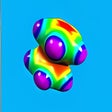
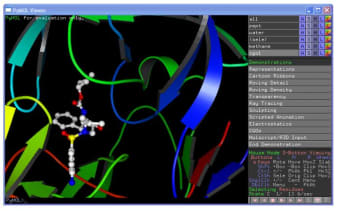
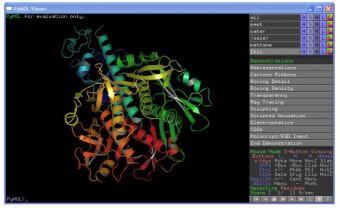
PyMOL allows scientists, educators, and students to explore 3D structures of molecules, DNA, and proteins. With its built-in ray-tracing graphics technology, the molecule models have smoother surfaces, enhanced shadows, and reflections—making them realistic when publishing images. There is a rotational camera and other adjustable options included, allowing you to choose what angle you want to capture. Additionally, the export feature supports multiple image formats.
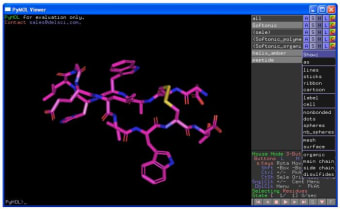
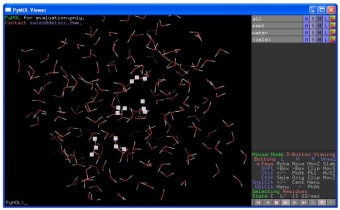
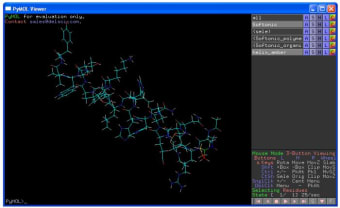
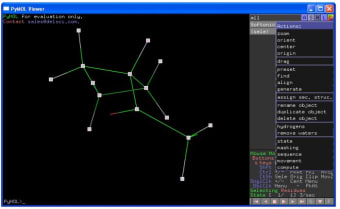
Upon using the software, you are greeted with an interface that looks overwhelming at first glance, but as soon as you familiarize yourself with its layout, you’ll realize how intuitive and useful it is with the amount of advanced features—from customizable visualizations to precise measuring tools, it’s a user-friendly experience for exploring complex molecular structures. Beginners and experienced users should have no problems using the software in the long run.
The software was written using the Python programming language, which allows for deep customization and scripting. This makes it easy for users to create complex visualizations and extend the software’s functionality to suit specific research needs. While the software can handle most molecules smoothly, larger models can slow down loading times, especially on less powerful computers. Higher-end computers shouldn’t experience this issue.
A modernized PyMOL experience
Recent PyMOL releases have expanded the software beyond its traditional visualization workflow. PyMOL 3 introduced a redesigned interface intended to make molecular visualization more intuitive while retaining the program’s established command-driven capabilities. The current 3.1 series also bundles Python 3.10, providing a more contemporary scripting environment for users who automate visualization or integrate the program into research workflows.
Updated platform compatibility
PyMOL has also received important compatibility improvements for modern computer systems. The current documentation lists PyMOL 3.0 and later for 64-bit Windows 11, macOS 13 or newer, and supported Linux distributions. On macOS, the software supports Apple Silicon M1 through M4 processors through Rosetta 2, allowing newer Mac hardware to run current releases without requiring older operating systems.
PyMOL 3.1 keeps development active
The software continues to receive releases rather than remaining solely a legacy molecular graphics package. PyMOL 3.1.8 was updated on March 18, 2026, with downloadable packages available for Windows, macOS, and Linux. The official distribution also provides an Anaconda installation route, giving technical users another method for deploying the application alongside scientific Python environments. A 2.6.2 LTS branch remains available for users who prefer the long-term-support release line.
Open-source foundation with commercial support
PyMOL currently follows a hybrid distribution model. Its source code is largely available under a permissive open-source license, while Schrödinger maintains and distributes the commercial product. Paid subscriptions provide software upgrades during the subscription period, technical support, and access to official documentation. Educational-use builds are also available at no cost for eligible teachers and students, although those builds have restrictions on research and publication use.
Expanded molecular analysis workflow
Beyond visualization, PyMOL’s documented ecosystem includes tools for more specialized structural work. Earlier feature expansions introduced trajectory-handling improvements, improved Maestro imports, nucleic-acid mutagenesis, stereochemical labeling, and enhanced interaction analysis. The platform also supports extensions through its open-source ecosystem, allowing experienced users to build additional functionality around the core visualization environment.
A continually evolving visualization platform
PyMOL remains centered on molecular visualization, but its current development shows a broader emphasis on modern interfaces, contemporary operating systems, Python integration, and continued cross-platform maintenance. With the 3.1 series actively maintained in 2026 and both commercial and open-source pathways available, the software continues to serve users who need detailed structural visualization without abandoning the scripting flexibility that has defined the software for years.
Powerful and reliable
Overall, PyMOL is a useful and reliable software for professionals, educators, and students working in the field of molecular biology. With its comprehensive set of advanced tools, it allows users to visualize complex molecular structures, analyze them, and create high-quality images and animations. Its combination of flexibility, precision, and powerful features makes it a highly sought-after resource for learning, research, and scientific presentations.